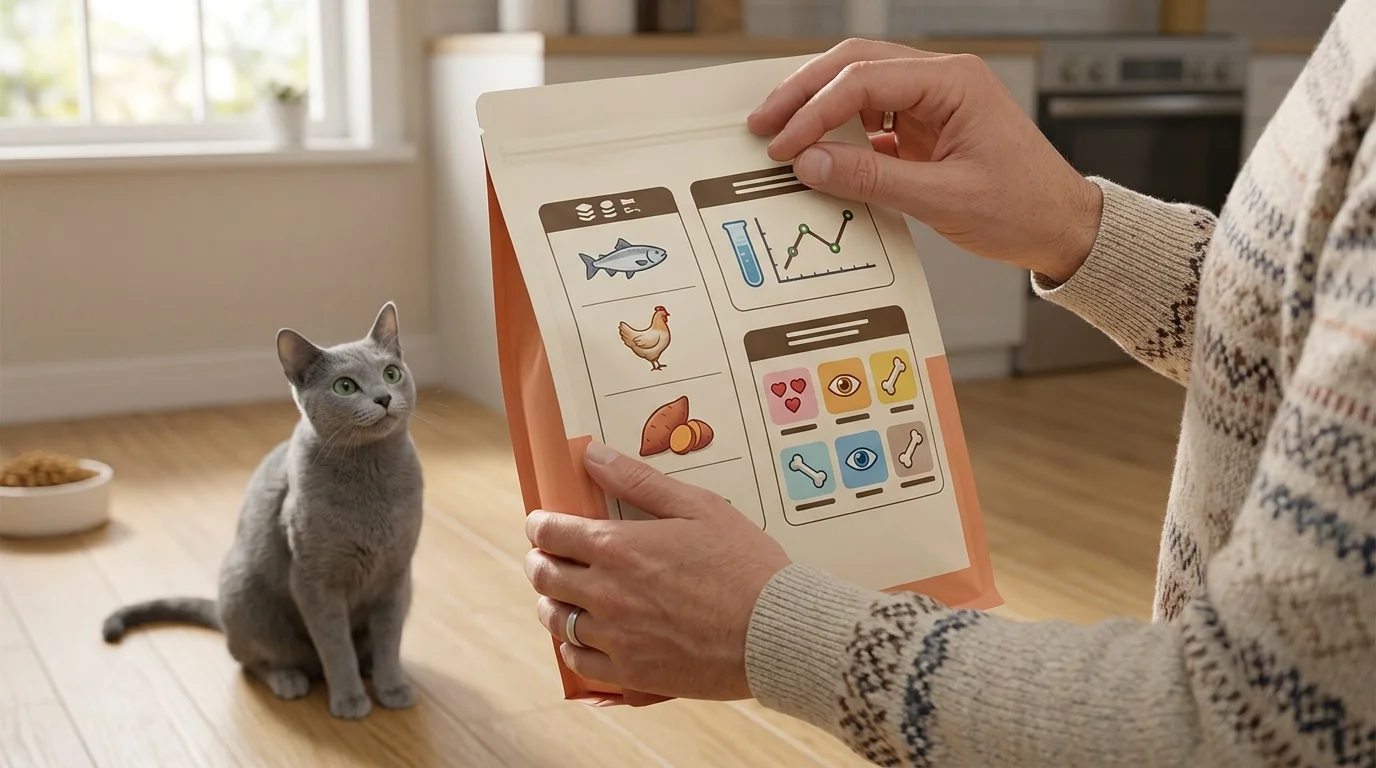
Walking down the pet food aisle can feel overwhelming. Bright bags feature enticing feline imagery and promise "Optimal Urinary Health," "Hairball Control," "Vet Recommended," and "Real Meat First." While these claims are designed to catch your eye, they rarely tell the whole story about what is actually inside the bag. Marketing terminology on pet food packaging is carefully crafted to influence buying decisions rather than provide precise transparency.
To understand what you are feeding your cat, turn the bag over and examine the pet food label itself. The back panel—specifically the ingredient list and guaranteed analysis—contains objective data required by regulatory authorities. Learning to translate this information allows you to look past branding, evaluate ingredient quality accurately, and make confident choices for your cat’s long-term health.
The Order of Ingredients: The Rule of the First Five
By law, pet food ingredients must be listed in descending order by weight before processing. This means items listed at the top make up the majority of the food’s volume. When evaluating a new recipe, focus heavily on the first five ingredients, as they represent the core foundation of the formula.
- Identifying Named Animal Proteins: Look for specific, named meat sources at the top of the list, such as "Chicken," "Deboned Salmon," or "Turkey." Avoid vague terms like "Meat," "Poultry," or "Animal Derivatives," which leave the actual origin of the protein completely ambiguous.
- Understanding Water Weight in Fresh Meat: Fresh meats like deboned chicken or fresh salmon contain up to 70% moisture. Because ingredients are weighed before cooking, much of that moisture evaporates during the extrusion process that creates dry kibble. A formula listing "Deboned Chicken" first may actually contain less total chicken protein once dehydrated than the dry grains or vegetables listed further down.
- The Value of Concentrated Meat Meals: High-quality, named meat meals—such as "Chicken Meal" or "Salmon Meal"—have already undergone a cooking process that removes water weight. Meat meal provides a concentrated, highly digestible source of protein. As long as the source species is clearly named, meat meal is an excellent, protein-dense ingredient for obligate carnivores like cats.
Exposing Common Marketing Tricks: Ingredient Splitting
One of the most widespread techniques used in pet food formulation is a strategy known as ingredient splitting. Manufacturers use this tactic to make protein sources appear more dominant on the label than they actually are.
- How Ingredient Splitting Works: Imagine a cat food recipe that uses a large quantity of corn. If the manufacturer lists all the corn as a single ingredient, "Corn" would be the heaviest item and would appear as ingredient number one. To avoid putting a plant ingredient first on a cat food bag, the formulator splits the corn into three separate categories: "Ground Yellow Corn," "Corn Gluten Meal," and "Corn Flour."
- The Illusion on the Label: Because the total weight of the corn is now divided across three smaller entries, each individual corn portion weighs less than the fresh chicken in the recipe. Consequently, "Deboned Chicken" moves up to the coveted first spot on the ingredient list, even though the combined weight of the three corn ingredients far outweighs the actual meat content in the final kibble.
- Spotting the Red Flags: To catch ingredient splitting, scan the entire ingredient list for repeated variations of the same plant or starch source. Common examples in cat food include split peas (pea protein, pea flour, green peas) and split wheat (whole wheat, wheat flour, wheat middlings).
Decoding the Guaranteed Analysis Panel
The Guaranteed Analysis provides a breakdown of the nutrient levels present in the food. While it does not measure ingredient quality directly, it provides essential metrics regarding macronutrient balances, which are especially critical for cats. Note that the word "Crude" simply refers to the testing method used to measure nutrients, not the cleanliness or quality of the ingredients.
- Crude Protein (Stated as a Minimum %): Essential for muscle maintenance, organ function, and enzyme production. Because cats are obligate carnivores, their minimum protein requirement is significantly higher than that of dogs.
- Crude Fat (Stated as a Minimum %): Serves as the primary concentrated energy source; supports healthy skin, a shiny coat, and metabolic function.
- Crude Fiber (Stated as a Maximum %): Promotes digestive regularity, healthy stool formation, and hairball movement through the digestive tract. Cats require relatively low fiber levels.
- Moisture (Stated as a Maximum %): Indicates water content; quality dry cat kibble typically stays under 10–12% moisture. Because cats have a naturally low thirst drive, paying attention to moisture—and supplementing with wet food—is vital for urinary tract health.
The Hidden Metric: Calculating Carbohydrates
Pet food regulations do not require manufacturers to list carbohydrate levels on the package. However, you can easily calculate the estimated carbohydrate percentage yourself using the data from the Guaranteed Analysis.
Simply add together the percentages of Protein, Fat, Fiber, Moisture, and Ash (if ash is not listed, estimate it at 6–8% for feline food), and subtract that total from 100. The remaining number represents the approximate percentage of carbohydrates in the diet.
As obligate carnivores, cats are biologically optimized for very low carbohydrate intake. High-quality dry cat foods generally aim for lower carbohydrate loads balanced with highly digestible animal proteins and healthy fats.
Additives, Supplements, and Red Flags to Avoid
The final section of the ingredient list contains microscopic amounts of vitamins, minerals, functional supplements, and preservatives. While many additives serve vital nutritional functions, others are best avoided.
- Mandatory and Beneficial Functional Additives: Look for feline-essential additives such as Taurine (an essential amino acid cats cannot produce on their own), Omega-3 fatty acids (from salmon oil or fish oil) for joint and skin health, and Probiotics for gut flora support.
- Artificial Preservatives to Avoid: Synthetic antioxidants like BHA (Butylated Hydroxyanisole), BHT (Butylated Hydroxytoluene), and Ethoxyquin are used to extend shelf life but have raised health concerns in long-term safety studies. Seek out foods preserved naturally with mixed tocopherols (Vitamin E), Vitamin C, or rosemary extract.
- Unnecessary Dyes and Fillers: Cats navigate their food using smell and taste, not sight. Artificial food dyes (such as Red 40, Yellow 5, or Blue 2) are added strictly to make the kibble look appealing to human buyers. They provide zero nutritional value and can trigger sensitivities.
Quick 4-Step Checklist for Your Next Store Visit
Next time you are evaluating a bag of cat kibble in the store, use this rapid assessment routine to separate high-quality recipes from clever packaging:
- Verify the First Two Ingredients: Ensure at least one named animal protein (e.g., Chicken, Dehydrated Salmon, Turkey Meal) occupies a top slot.
- Scan for Ingredient Splitting: Check if the same grain, legume, or starch appears under multiple names across the list.
- Check for Essential Nutrients & Preservatives: Ensure Taurine is explicitly listed and look for natural preservation systems like "Mixed Tocopherols" near the very end of the panel.
- Locate the AAFCO Statement: Ensure the package carries a nutritional adequacy statement confirming the food is formulated to meet standard nutritional profiles for your cat's specific life stage (Kitten, Adult, or All Life Stages).
Becoming a conscious pet owner is one of the most effective ways to protect your cat’s vitality. By looking past surface marketing and focusing on ingredient transparency, you can ensure that every meal in your cat's bowl contributes directly to a long and healthy life.
Frequently Asked Questions
Why are cats called "obligate carnivores"?
Unlike dogs, cats must consume animal products to survive. They cannot synthesize certain essential nutrients, such as taurine, preformed Vitamin A, and arachidonic acid, from plant sources. These nutrients are mandatory for their survival and health, making named animal proteins non-negotiable on feline food labels.
How do I calculate the carbohydrates in my cat’s dry food?
Since manufacturers are not required to list carbohydrates, you can estimate them using the Guaranteed Analysis. Add up the guaranteed percentages of Crude Protein, Crude Fat, Crude Fiber, Moisture, and estimate Ash at 7%. Subtract this total from 100 to find the approximate carbohydrate percentage in the diet.
What is the most critical additive to check for on a cat food label?
Taurine is the most critical amino acid additive for cats. Because cats cannot synthesize taurine on their own and a deficiency leads to severe heart conditions and vision loss, you must ensure named animal proteins occupy the top slots and Taurine is explicitly listed in the additive panel.
Are grain-free cat foods always lower in carbohydrates?
Not necessarily. While grain-free formulas replace ingredients like corn or wheat, manufacturers often substitute them with high-starch alternatives like potatoes, lentils, or split peas. These ingredients can still result in a high overall carbohydrate load, which is why calculating the carbohydrates manually remains important.
Why is a named "Meat Meal" beneficial in dry cat food?
Named meat meals, such as "Chicken Meal" or "Turkey Meal," are concentrated sources of animal protein because they have already been cooked to remove water weight. Fresh meat contains up to 70% water before processing, whereas a named meat meal provides a dense, highly digestible protein source that stays intact after kibble extrusion.
The information provided on this blog is for educational and informational purposes only and does not constitute veterinary medical advice. Always consult a qualified veterinarian for any questions regarding your pet's health or behavior.